
IIT Roorkee has published the candidates' JEE Advanced 2026 responses for both Paper 1 and Paper 2 on 21 May 2026 at 5:00 PM on the official site - jeeadv.ac.in/index.html.
Approximately 1.9 lakh candidates who took the exam will have the opportunity to access their JEE Advanced response sheet using their Application Number and Password.
| Direct link to access the JEE Advanced 2026 Response Sheet – (Out) |
- The Provisional Answer keys will be made available on Monday, May 25, 2026, at 10:00 AM.
- Additionally, IIT Roorkee will initiate an objection window from 25 May at 10:00 AM, allowing candidates to raise objections regarding the answer key until 26 May at 5:00 PM.
- Candidates can estimate their scores using the provisional answer key and the response sheet prior to the announcement of results.
- After addressing all objections, the Final Answer key, along with the results, will be published on Monday, June 01, 2026, at 10:00 AM.
The online registration for JEE Advanced Architecture Aptitude Test (AAT) 2026 will commence on 1st June 2026 at 10:00 AM (Monday) and will continue until 2nd June 2026 (5:00 PM).
Related Links:
- JEE Advanced Response Sheet 2026 (Out): How to Download, Marks vs rank, & Answer key vs response sheet
- JEE Advanced 2026 Answer Key: Release Dates, How to Challenge, Previous Year Answer Key PDF
- JEE Advanced 2026 Result: Direct Link @jeeadv.ac.in, Scorecard, Toppers, Marks vs Rank and Cutoff
- JEE Advanced Marks vs Rank 2026: Check Category-wise marks vs rank, minimum marks required & cutoff
Key Summary
This article covers the registration process, eligibility criteria, syllabus, exam format, preparation strategies, and previous year questions or mock tests.
- According to trends, in 2026 there could be approximately 1,85,000 registrations from JEE Main-qualified candidates vying for nearly 18,200 seats across 23 IITs.
- The syllabus is derived from Class 11 & 12, with numerical and multi-correct questions accounting for about 50% of the total weightage.
- To gain admission, all candidates must secure 75% aggregate in their Board examinations, or rank within the Top 20 Percentile of their respective boards.
- Candidates must achieve a Minimum Percentage of Marks per subject to avoid disqualification, even if they have a high aggregate score.
- What is JEE Advanced?
- JEE Advanced 2026 Highlights
- Important Dates
- JEE Advanced 2026 Registration
- JEE Advanced 2026 Exam Pattern
- JEE Advanced 2026 Marks Distribution
- JEE Advanced 2026 Syllabus
- JEE Advanced PYQs
- JEE Advanced 2026 Qualifying Marks
- 4-Month Preparation Strategy
- JEE Advanced Mock Test
- JEE Advanced Topper’s Strategy
- JEE Advanced 2026 FAQs
What is JEE Advanced?
The Joint Entrance Examination (JEE) Advanced is a national-level entrance test for students aiming to secure a spot in IITs across India.
- The examination consists of two compulsory papers: Paper 1 and Paper 2, both held on the same day in two shifts.
- Both papers will be administered in CBT mode, featuring 17 questions in Physics, Chemistry, and Mathematics respectively.
- Success in this examination leads to admission into undergraduate engineering and science programs at Top IITs and other institutions such as IISc, IIPE, IIST, RGIPT, etc.
In the previous year, out of 250,000 candidates who qualified for JEE Main, only around 75% registered for the exam, with 54,378 candidates qualifying for admission, while only 18,188 seats were available across 23 IITs through JoSAA.
- The Joint Implementation Committee (JIC) establishes a minimum qualifying score to ensure approximately three candidates per available seat.
- This is necessary as many top scorers may opt out of counselling to enroll in other prestigious non-IITs (like IISc, IIST, and IISERs) or preferred NITs or less sought-after IITs based on their choices and seat availability.
For a comprehensive guide to the exam, you can check out this video by @Exams
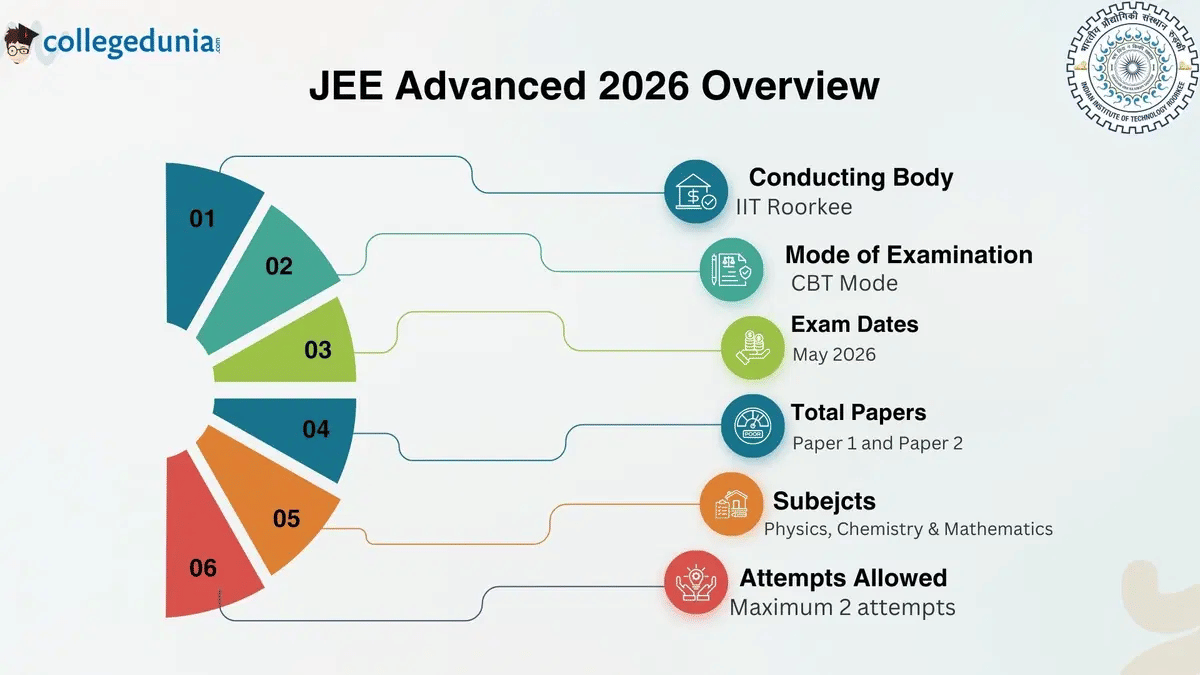
JEE Advanced 2026 Highlights
| Particulars | Details |
|---|---|
| Governing Body | IIT Council |
| Exam Level | National Entrance Test |
| Exam Mode | Online (CBT) |
| Papers | Paper 1 and Paper 2 |
| Subjects | Physics, Chemistry, Mathematics |
| Medium | English & Hindi |
| Exam Date | 17 May 2026 |
| Registration Dates | 23 April 2026, 10 am to 02 May 2026 |
| Eligibility | Top 250,000 JEE Main 2026 qualifiers |
| No. of Attempts allowed | 2 attempts (consecutive years) |
| Total Questions | 102 questions (51 questions in each paper) |
| Expected Seat Intake | 18,200 across 23 IITs |
| Information Brochure | PDF Link (English) |
| Official Website | jeeadv.ac.in |
Key Dates
| Date (Timeline) | Event |
|---|---|
| 21 May 2026 (5:00 PM) | JEE Advanced Response Sheet (Released) |
| 25 May 2026 (10:00 AM) | JEE Advanced Provisional Answer Key |
| 25-26 May 2026 | JEE Advanced Challenge Window |
| 1 June 2026 | JEE Advanced Results |
| 17 May 2026 | JEE Advanced 2026 Exam (Completed) |
| 11 May 2026, 12 PM - 17 May 2026, 2:30 PM | Admit Card Dates (Released) |
| 16th May 2026 | Selection of a scribe by PwD candidates |
| 17 May 2026 | JEE Advanced Exam Date |
| Paper 1: 9 am-12 pm Paper 2: 2:30pm - 5:30pm | Paper Timing Slots |
| 6 April 2026, 10 am | Online Registration Start Date (Foreign National and OCI/PIO (F) Candidates) |
| 23 April 2026, 10am – 5 May 2026 11:59 PM (Closed) | Online Registration Start Date (for JEE Main 2026 Qualified Candidates) |
Source: jeeadv.ac.in
Ques. What determines which IIT will organize the JEE Advanced exam?
Ans. This year, IIT Roorkee is responsible for conducting the JEE Advanced 2026. The selection follows a rotational system among the IITs that operates on a 7-year cycle, allowing each of the seven zonal IITs to host the exam in turn. IIT Roorkee last held the JEE Advanced in 2019, making it their turn again in 2026 according to this cycle.
- The IITs rotate every year in a 7-year cycle to manage the JEE Advanced exam.
- IIT Roorkee's previous organization of the JEE Advanced was in 2019, thus it is their turn again in 2026.
Ques. What are the differences in the exam pattern of JEE Advanced compared to JEE Main?
Ans. The primary distinctions between the two exams are as follows:
| Feature | JEE Main | JEE Advanced |
|---|---|---|
| Conducting Body | NTA | One of the 7 older IITs |
| Entrance Exams | NITs, IITs, GFTIs | Primarily for IITs |
| Eligibility | Class 12 appearing/passed | Top 2,50,000 JEE Main qualifiers |
| Attempts | 3 years (2 sessions/year) | 2 attempts in 2 consecutive years |
| Exam Level | Easier Than Advanced | Very Challenging |
| Subjects | Physics, Chemistry, Mathematics | Physics, Chemistry, Mathematics |
JEE Advanced 2026 Registration
The registration process for JEE Advanced 2026 commenced on April 23, 2026, following the announcement of JEE Mains Results. The registration portal will remain open until May 2, 2026, at 11:59 PM.
Read More: How to register for the exam?
JEE Advanced 2026 Registration Fees
The registration fee for JEE Advanced remains consistent with the previous year. The fee structure is anticipated to vary based on the candidate’s category, gender, and nationality.
JEE Advanced 2026 Registration Fees
Source: jeeadv.ac.in
… Read More Read Less
JEE Advanced Registration Trends
Over the past few years (2023 to 2025), the difference between registered and appeared candidates has typically ranged from approximately 4,000 to 9,000, showcasing high turnout rates.
- Registrations have steadily increased from about 150,000–170,000 (2017 to 2022) to around 180,000–190,000 in the years 2023 to 2025.
- During 2023 to 2025, the number of candidates who took the exam was roughly around 180,000.
| Year | Registered Candidates | Appeared Candidates |
|---|---|---|
| 2017 | 171,814 | 159,540 |
| 2018 | 165,656 | 155,158 |
| 2019 | 174,432 | 161,319 |
| 2020 | 160,838 | 150,838 |
| 2021 | 151,193 | 141,699 |
| 2022 | 160,038 | 155,538 |
| 2023 | 189,744 | 180,372 |
| 2024 | 186,584 | 180,200 |
| 2025 | 187,223 | 180,422 |
Ques. What if I improved my board (12th) marks this year? Which marksheet do I upload?
Ans. For the JEE Advanced 2026 registration, several essential documents are required:
- Primary Document: You must upload your 2025 improvement exam marksheet during the JEE Advanced 2026 registration.
- Supporting Documents: In addition to the Class 12 marksheet from 2025, you should also upload your original Class 12 marksheet from 2024.
- Calculation of Best Marks: For subjects where you have taken improvement exams, the highest marks will be taken from either the 2024 or 2025 exams.
- For JEE Main 2026 and JoSAA Counselling, you will need to submit both your 2024 and 2025 marksheets to verify that you meet the 75% aggregate marks requirement or are in the top 20 percentile of your board.
Ques. If I didn’t renew/get an EWS certificate during JEE Main, can I still apply under EWS during Advanced registration?
Ans. Yes, you can apply under the GEN-EWS Category when registering for JEE Advanced 2026.
- GEN-EWS Certificate Requirement: You must upload a valid GEN-EWS certificate issued on or after April 1, 2025, during the JEE Advanced 2025 registration process.
- Declaration in place of Certificate: If you are unable to obtain the GEN-EWS certificate before the registration deadline, you may submit a self-declaration confirming that you belong to the GEN-EWS category.
JEE Advanced 2026 Exam Pattern
The JEE Advanced 2026 Exam is scheduled to take place in an online CBT format, consisting of two mandatory papers: Paper 1 and Paper 2, each lasting 3 hours.
This exam will assess candidates in Physics, Chemistry, and Mathematics through various question types, including MCQs, MSQs, and NAT Questions.
Image not available
Source: Official Information Brochure
JEE Advanced 2026 Paper 1
Paper 1 is set to occur on 17 May 2026, with timings from 9am to 12pm.
- This paper will evaluate conceptual understanding along with precision in Mixed MCQs, NATs, and Matching Questions.
- Partial credit will be awarded for Multiple correct MCQs, while NAT Questions will not incur negative marking.
Paper 1 Pattern (subject-wise)
| Section | Type of Questions | No. of Questions | Marking Scheme | Total Marks |
|---|---|---|---|---|
| 1 | Single Correct MCQs | 4 | +3 for correct, -1 for incorrect, 0 for unattempted | 12 |
| 2 | Multiple Correct MCQs | 3 | +4 (all correct), +3 (3 out of 4 correct), +2 (2 correct), +1 (1 correct), 0 (none), -2 (others) | 12 |
| 3 | Numerical Answer Type (NAT) | 6 | +4 for correct, no negative marking | 24 |
| 4 | Matrix Match | 4 (2) | +4 for fully correct, -1 for incorrect, 0 for unattempted | 12 |
| Total | 17 | 60 |
… Read More Read Less
Thus, the total marks for Paper 1 in JEE Advanced 2026 are
Physics + Chemistry + Mathematics = 60 + 60 + 60 = 180 Marks
JEE Advanced 2026 Paper 2
Paper 2 will be held on 17 May 2026, with timings from 2:30pm to 5:30pm.
- This paper is anticipated to be more extensive, featuring both objective-type and numerical problem-solving questions with complex NATs.
- There will be an increased number of Numerical Answer Questions that will benefit candidates in solving.
Paper 2 Pattern (subject-wise)
| Section | Type of Questions | No. of Questions | Total Marks |
|---|---|---|---|
| 1 | Single Correct MCQs | 4 | 12 |
| 2 | Multiple Correct MCQs | 3 | 12 |
| 3 | Numerical Answer Type (NAT) | 6 | 24 |
| 4 | Paragraphs | 4 (2) | 12 |
| Total | 17 | 60 |
Therefore, the total marks for Paper 2 in JEE Advanced 2026 are
Physics + Chemistry + Mathematics = 60 + 60 + 60 = 180 Marks
Also Read: What is the pattern for the exam paper?
JEE Advanced 2026 Marks Distribution
The JEE Advanced does not have a standardized marking scheme. Each year, the exam format, number of questions, and marking criteria differ and are specified during the exam in the question paper.
JEE Advanced 2026 Marks Distribution
Read More: How to calculate ranks out of marks?
Ques. What about exam duration and extra time for PwD?
Ans. Each paper in JEE Advanced lasts for 3 hours, totaling 6 hours for both papers.
Candidates with at least 40% disability are entitled to an additional hour per paper, resulting in a total of 8 hours and 4 hours per paper.
Ques. Will the question types change (MCQ / Numerical, matching, etc.) in 2026?
Ans. Yes, the question formats in JEE Advanced 2026 are anticipated to be similar to those in previous years, and the official exam pattern will soon be made available on the official website:
- Multiple Choice Questions (MCQs): Includes both single-correct and multiple-correct answer questions.
- Numerical Answer Type (NAT) Questions: Questions that require a numerical response.
- Match the Following: Questions that involve matching items from two lists.
- Integer-based Questions: Questions where the answer must be an integer.
JEE Advanced 2026 Syllabus
The syllabus for JEE Advanced 2026 has been announced and is accessible on the official site at jeeadv.ac.in.
- The JEE Advanced 2026 Syllabus adheres to the NCERT Class 11 & 12 curriculum in Physics, Chemistry, and Mathematics, emphasizing the application and integration of concepts.
- Paper 1 of JEE Advanced concentrates on fundamental principles and their applications, while Paper 2 assesses more advanced topics.
JEE Advanced Paper 1 Syllabus
- Paper 1 encompasses the foundational aspects of all subjects.
- Emphasis is placed on Mechanics, Algebra, and Physical Chemistry.
- Questions focus on practical application, necessitating strong problem-solving skills.
| Subject | Key Topics |
|---|---|
| Physics | Mechanics, Thermodynamics, Waves and Oscillations, Electrodynamics, Modern Physics |
| Chemistry |
|
| Mathematics | Algebra, Probability and Statistics, Trigonometry, Differential Calculus and Vectors, Coordinate Geometry |
… Read More Read Less
JEE Advanced Paper 2 Syllabus
- Paper 2 emphasizes advanced problem-solving techniques.
- It includes topics such as Optics, Modern Physics, Organic Chemistry, and Advanced Calculus.
| Subject | Key Topics |
|---|---|
| Physics | Rotational Dynamics, Gravitation, Electromagnetic Waves, Optics, Modern Physics |
| Chemistry |
|
| Mathematics | Matrices and Determinants, Differential Equations, 3D Geometry, Integral Calculus and Vectors |
Source: jeeadv.ac.in/syllabus.pdf
Ques. Will there be questions outside the syllabus in JEE Advanced 2026?
Ans. No official announcement has been made regarding out-of-syllabus questions for JEE Advanced 2026.
The JEE Advanced examination is recognized for its challenging and unpredictable nature; while questions are anticipated to come from the syllabus, which encompasses topics from Physics, Chemistry, and Mathematics according to the NCERT curriculum for Classes 11 and 12.
Ques. What are the differences between Advanced-level and Main-level concepts in Physics and Chemistry?
Ans. There are notable differences in the conceptual approach between the Main and Advanced Exam Patterns:
- In JEE Main, the questions are generally more straightforward, focusing on fundamental understanding, direct application of formulas, moderately challenging problems, and some combinatorial questions.
- Conversely, JEE Advanced questions demand a deeper conceptual grasp, integration of multiple concepts, complex variations, application under diverse conditions, more rigorous derivations, and a higher level of difficulty.
JEE Advanced PYQs
| Question Paper Name | Question Paper PDF |
|---|---|
| JEE Advanced 2025 | Click Here |
| JEE Advanced 2024 | Click Here |
| JEE Advanced 2023 | Click Here |
| JEE Advanced 2022 | Click Here |
| JEE Advanced 2021 | Click Here |
| JEE Advanced 2020 | Click Here |
| JEE Advanced 2019 | Click Here |
| JEE Advanced 2018 | Click Here |
| JEE Advanced 2017 | Click Here |
| JEE Advanced 2016 | Click Here |
Read More: The significant changes in the paper and detailed papers with solution PDF
Related News Link: Are PYQs relevant for the JEE Advanced 2026 exam?
JEE Advanced 2026 Qualifying Marks
To qualify for the JEE Advanced rank list, candidates must achieve the category-specific minimum marks in each subject based on previous years' data.
JEE Advanced Expected Qualifying Marks 2026
For the Common Rank List (CRL), candidates need at least 7 marks in each subject, totaling 74 marks.
For SC/ST candidates, the requirement is 3 marks per subject and a total of 37 marks.
| Category/Rank List | Minimum Marks Subject-Wise | Minimum Aggregate Marks (out of 300) |
|---|---|---|
| Common Rank List (CRL) | 7 marks | 74 marks (20.56%) |
| GEN-EWS | 6 marks | 66 marks (18.33%) |
| OBC-NCL | 6 marks | 66 marks (18.33%) |
| SC/ST/PwD (all lists) | 3 marks | 37 marks (10.28%) |
| Preparatory Course (PC) | 1 mark | 18 marks (5%) |
4-Month Preparation Plan
This strategy is designed to align with exam patterns: subject cut-offs, section-wise scoring, and the combined scores of Paper 1 & Paper 2.
| Duration | Focus Area | Action Items |
|---|---|---|
| Week 1–4 | Pattern & Weakness Identification | Review the past 10–15 years of question papers; categorize questions by type and subject; pinpoint cutoff-risk areas in Physics, Chemistry, and Mathematics |
| Conceptual Gaps | Focus on revising weaker topics from Class 11 initially, followed by Class 12; re-derive formulas utilized in previous years' questions | |
| Error Analysis | Keep a log of errors; categorize mistakes into logical, computational, and reading errors | |
| Week 5–8 | Section-wise Practice | Practice single-choice, multiple-correct, numerical, and matrix match questions separately; limit attempts in sections with high negative marking |
| Numerical Precision | Concentrate on calculation accuracy and estimation; refrain from guesswork | |
| Subject Proficiency | Enhance performance in the lowest-scoring subject to remain above the cutoff threshold | |
| Week 9–12 | Paper Attempting | Individually solve Paper 1 and Paper 2, then practice them together under full exam conditions |
| Time Management | Establish a fixed order of attempts; set rules for skipping difficult questions | |
| Practice Regimen | Engage in continuous 6-hour mock exams weekly | |
| Week 13–16 | Attempting Strategy | Finalize a strategy distinguishing between safe and risky attempts; minimize excessive attempts |
| Error Mitigation | Address recurring errors from logs; enhance option verification | |
| Final Review | Review only formulas and concepts based on previous years' questions; avoid introducing new study materials |
JEE Advanced Mock Test
Below are the links to full-length mock tests that you can attempt directly based on the difficulty level of the papers and within the allotted time:
| JEE Advanced Mock Tests | Test Links | Difficulty Level of Mock Test |
|---|---|---|
| Mock Test 1 | Click Here | Basic |
| Mock Test 2 | Click Here | Basic |
| Mock Test 3 | Click Here | Basic |
| Mock Test 4 | Click Here | Basic |
| Mock Test 5 | Click Here | Advanced |
JEE Advanced Topper’s Strategy
This video by @ALLEN JEE features an in-depth interview with Rajit Gupta, who achieved AIR-1 in JEE Advanced 2025. He shared insights into his preparation journey, study techniques, and mindset for the highly competitive IIT entrance exams.
Key Insights:
- Adopting a flexible daily study routine, rather than sticking to strict schedules, allows students to concentrate better on the syllabus.
- Consistent effort with the right guidance is essential for success.
Exam Day Approach:
- A calm and composed approach, utilizing test practice to handle exam stress and maintain temperament.
- The exam demands innovative thinking and a comprehensive preparation strategy.
Final Advice:
“Hard work has no substitute. Only hard work can lead to success.”
JEE Advanced 2026 FAQs
Ques. What is the significance of 75% board marks vs Top 20 Percentile?
Ans. To gain admission through JEE Advanced into an IIT, you must satisfy at least one of the following conditions:
- 75% Board Marks: You need to achieve a minimum of 75% aggregate marks in your Class 12 (or equivalent) board examination for General/EWS/OBC candidates, and 65% for SC/ST candidates.
- Top 20 Percentile in Board: If you do not meet the 75% requirement, you may still qualify if you are in the top 20th percentile of successful candidates in your Class 12 board exams.
Ques. If I am a dropper (did not qualify last year / didn’t register), can I still register now?
Ans. Yes, if you are a dropper and did not qualify for JEE Advanced in previous years or opted not to register, you can still sign up for JEE Advanced 2026:
- You must have taken the Class 12 (or equivalent) examination for the first time in 2024 or 2025.
- You need to have qualified for JEE Main 2026 and be among the top 2,50,000 candidates (across all categories).
- Your birth date should be on or after October 1, 2000 (or October 1, 1995 for SC, ST, and PwD candidates).
Ques. What is the distribution of seats among various categories?
Ans. The seat distribution for JEE Advanced is as follows:
- General (GEN): ~40%
- OBC-NCL: ~27%
- SC: ~15%
- ST: ~7.5%
- EWS: ~10%
- PwD: Reserved within each category
Ques. What should I do if I face issues while downloading the admit card?
Ans. If you encounter problems with downloading the admit card, ensure to check the following before reaching out to officials:
- Look at the official website for any server downtime or maintenance updates.
- Make sure you have a stable internet connection and disable pop-up blockers.
- Carefully verify your login credentials (application number, date of birth, password).
- If the problem continues, reach out to the exam authority’s helpline or email support with your registration details.
Ques. Is the JEE Advanced exam challenging?
Ans. Indeed, the JEE Advanced exam is recognized as one of the most challenging engineering entrance exams, requiring a profound understanding of concepts, analytical skills, and quick problem-solving abilities beyond what is expected in JEE Main.
- It includes complex, multi-concept questions and has low success rates (6-10%), necessitating a solid foundation and extensive preparation.
- The exam demands a deeper comprehension and analytical capability, featuring fewer but more difficult, multi-step problems.